The right partnership
makes eleven.

The right partner doesn't add to what a business can do, or even multiply it. They bring both sides together so the result compounds. We partner with licensed professionals to transform how your business runs, and every improvement builds on the last.

AI is for everyone, not for everythingHalf the value of a diagnosis is the list of things to leave alone.
Audit firstWe analyze before we propose. Sometimes the answer is process improvement, not software.
The Audit decidesYour proposal contains only what the findings support. You choose the package.
Human guardrails where they matter mostAutonomy is set to your needs, workflow by workflow. Some run end-to-end; the ones that carry risk keep a person on approval.
The first ten minutes

You bring the question. We draw the machine behind it.

Nobody hires us for AI. They hire us because something takes eleven days that should take two, and no one can say which of those days is judgment. The diagnostic finds out.

Makes Eleven · Workflow Mapper Mapping
  

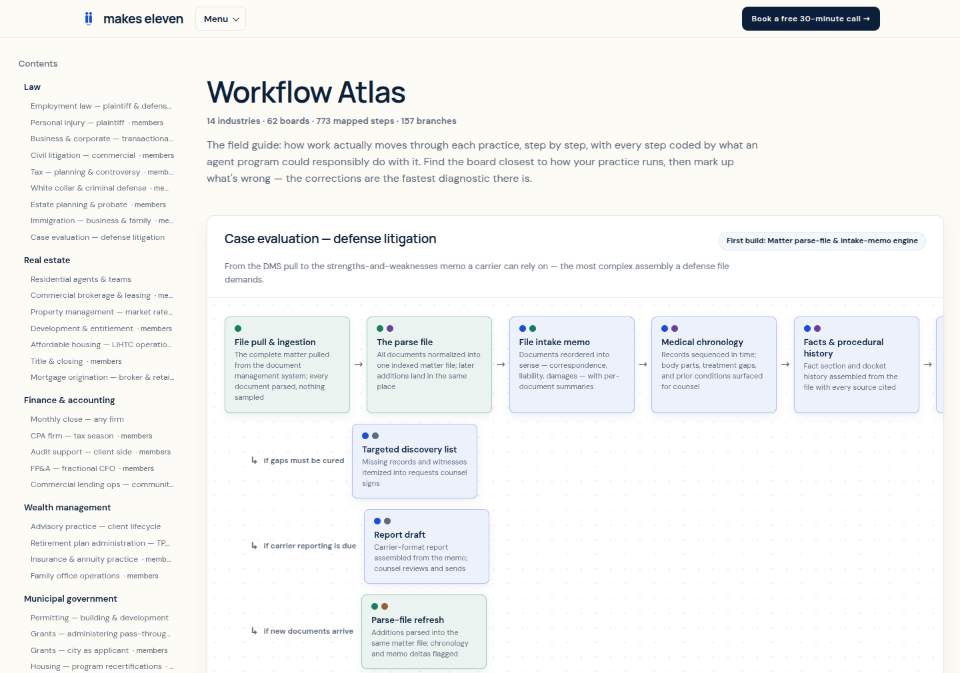
Illustrative maps built from the Workflow Atlas. Your diagnostic maps your firm, not a template. Open the Workflow Atlas →
The systems you already run

We build into your stack. We don’t ask you to leave it.

Agents read from and write to the systems your team already lives in: ledgers, portals, practice management, the drive, the inbox. No migration required.

All logos, product names and company names are trademarks of their respective owners, shown solely to identify systems we integrate with. No affiliation, partnership, sponsorship, or endorsement is implied.

How we price
Scoped

Priced to the work we scope together. A national rollout and a six-person practice are never the same quote.

Market evidence
0–80%

Of listed businesses never sell, and messy financials are a leading killer. We fix that before it costs you.
Source: IBBA Market Pulse reporting

Market evidence
~0K

Actively licensed US CPAs remain, down from ~1.9M in 2019. We built for the shortage: agents do volume, CPAs review and approve.
Source: AICPA Trends · NASBA

The machine underneath

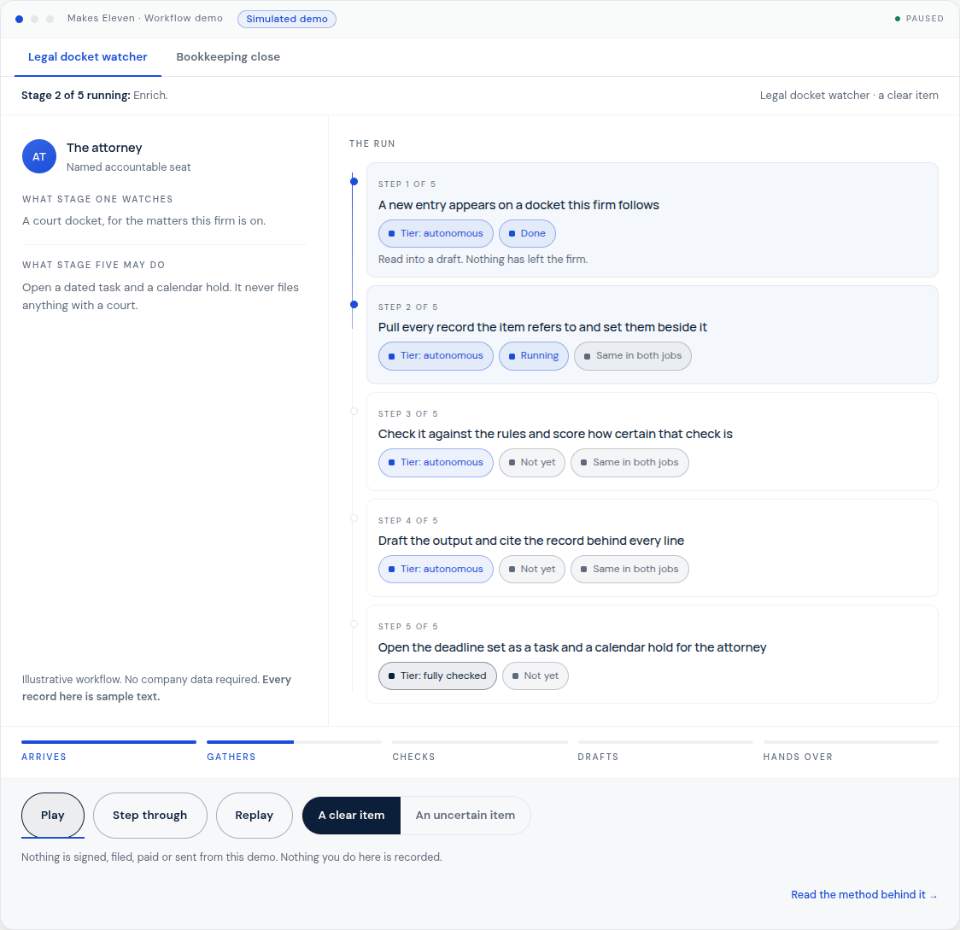
Every system we build is the same five-stage engine.

Stage 01

Signal

Watch the sources that matter: dockets, deadlines, ledgers, portals. The signal layer is the moat.

Stage 02

Enrich

Pull the context that turns a raw event into a fact about your business.

Stage 03

Score

Decide if it matters, how much, and how confident we are. In numbers, not vibes.

Stage 04

Compose

Draft the artifact: the reconciliation, the filing, the follow-up, the report.

Stage 05

Act

File it, chase it, escalate it, or hand it to a human. The tier decides.

Solutions compound when each agent holds a narrow scope and works inside a system. One well-bounded step earns the next.

Only two things change between a legal docket watcher and a bookkeeping close agent: what stage one watches and what stage five may do. Every engagement hardens the same spine.

Your people stop retyping and start ideating, because the machine carries the volume and hands them the exceptions worth thinking about.

Four ways we engage

Everything we sell carries one of four labels.

Bespoke · by engagement

Consulting

Intake and diagnosis, workflow redesign, GAAP and compliance interpretation, exit readiness, audit prep. Judgment-heavy work, done with you. The front door to everything else.

Productized · monthly

Agents

Software teammates that run a repeatable task end-to-end: bookkeeping and close, eligibility checks, document intake, monitoring. Reviewed by licensed professionals, measured against day one.

Recurring · your internal intelligence

Dashboards

Your own data, queryable in plain English. Sourced answers or a refusal, never a guess.

Enablement · the other half of eleven

Training

Executive briefings that book directly, and training anchored to the workflows we build for you.

High-impact starting points

Where firms start.

Pick your world, or the function that hurts. Each tab shows what we take off a team's plate first, and the playbook behind it.

Careful by architecture

Trust is a promise we designed for.

Per-client isolation. Nothing trains on your data. Licensed sign-off on everything regulated. Sourced answers or a refusal.

Method

Diagnose. Propose.
Deliver. Compound.

Every engagement runs the same arc, and every stage produces something you keep.

1

Diagnose

We map how work actually flows through your firm: the systems, the handoffs, the workarounds nobody wrote down. The written diagnostic says what to automate, what to fix first, and what to leave alone. You keep it either way.

Scoped to your firm · credited toward the engagement that follows
2

Propose

You receive a written proposal with package options: only what the diagnosis supports. If the honest answer is advice, an introduction, or nothing, that's what the proposal says. You choose; we never choose for you.

Scope drivers fixed · you select the package
3

Deliver

Agents are built against our written reliability standard: autonomy tiers per task, a prohibited-actions register, and a separate examiner who checks what the builder built. Licensed CPAs review financial deliverables. A human approves anything that leaves the building.

Scope and ceiling agreed in writing before work begins
4

Compound

We measure hours, error rates, and cycle times against your day-one baseline, and publish the delta monthly. What proves out, scales. What doesn't, we stop.

Measured against day one · scale follows proof
The refusal list

What we will not do. Printed, not just implied.

An honest system is defined by its boundaries. These are aspirations we made contractual.

  • No agent signs, files, or pays. Returns, government filings, and payments always carry a human signature.
  • No tax positions, no valuation opinions. Judgment that belongs to a licensed professional stays with one.
  • Nothing unsupported by the diagnosis. If you don't need it, it isn't in the proposal, even when it would be easy to sell.
  • No claims we can't reproduce. Every number we publish about our own work traces to a real engagement record.
  • No surprise invoices. Whatever we agree becomes a written ceiling before work begins, and it holds for the term.
Enablement

People are the other half of eleven.

Executive AI briefing

For leadership and boards: what AI is and isn't, the risks that apply to you, and the questions you'll be asked. Books directly; no diagnosis required.

Workflow-anchored training

Built on your diagnosis and what we implement, so your people learn on their own work. Governance, acceptable-use policy, and standing office hours where the diagnosis supports them.

We build capability; we don't certify it.

Solutions

Two ways in: your industry,
or the function that hurts.

The same engine, cut two ways. Choose the vertical you live in, or the part of your business that needs to run better. The diagnosis meets you at either door.

Every function, one engine

Pick the function that hurts. The machine underneath is the same.

Signal, enrich, score, compose, act runs any function where documents move, deadlines bind, and follow-up decides outcomes. The diagnosis picks where proof lands fastest for your firm, not where we happen to sell hardest.

Accounting

Clean records, reconciled accounts, and a close that happens on a date. Agents assemble; licensed CPAs review and approve. The Books Ladder below shows the rungs.

Finance & FP&A

A 13-week cash forecast that reconciles to the ledger, not to hope. Variance flagged with sources attached.

HR & People

Onboarding and offboarding chases that never lose a step; credential and license expiry watched continuously.

Operations

The exception board: one queue for everything stuck, with an owner and a clock on every item.

Marketing & Growth

First-party lifecycle triggers on consented channels only. Relevance from your own data. No scraping, no purchased lists.

Sales & CRM

Pipeline hygiene enforced automatically; quote-to-close follow-up that's polite, relentless, and logged.

IT & Data

Access reviews on schedule, unused licenses reclaimed, backups verified by restoring them, not by trusting the checkbox.

Compliance & Risk

Obligations tracked from the governing documents, filings calendared with margins, evidence collected as the year happens.

Legal & Contracts

Renewal and notice dates computed from the contracts themselves; obligations surfaced before they bite.

Customer service & Front office

Intake triaged, routine questions answered from approved sources, the rest routed to a human with context attached.

Procurement & Vendors

Invoices reconciled against contracts and price lists; vendor documents chased; renewals never auto-renewed unseen.

Data & Reporting

Numbers assembled, sourced, and explained on schedule. Your own data, queryable in plain English.

The Books Ladder

Five rungs. You enter wherever your books actually are.

GAAP is triggered, not defaulted. We recommend the full climb when something real demands it: an exit inside two years, institutional financing, bonding, outside investors. No trigger? An honest stop at rung three. For sell-side advisors: we prepare sellers' books for diligence with no referral fees in either direction, so the introduction stays clean.

Real estate & Affordable housing

Development programs, property operations, resident notices, rent and subsidy reconciliation. The operational spine of a portfolio, run on time.

Lead playbookAgent program on the responsibility matrix

LIHTC compliance

Low-income housing tax credits, specifically: income certifications and recerts, agency deadlines, audit files. Documentation is everything and the deadlines are federal.

Lead playbookCompliance operations

General compliance, any industry

Whatever your regulator requires: obligations tracked from the governing documents, evidenced continuously, never late. Portable across sectors.

Lead playbookWatch, calendar & Evidence

Dental & Medical practices

Eligibility checks before visits, claim assembly, denial chase, recall outreach. The intake-heavy workflows that eat front-office hours.

Lead playbookRevenue-cycle automation

Legal & Policy firms

Docket and deadline tracking, matter intake, legislative monitoring fused with your client book. Every alert lands as per-client positioning.

Lead playbookPolicy & Monitoring

Restaurants & Hospitality

Supplier invoices checked against agreed prices, inventory variance, license renewals, daily sales and labor reporting. Margin defense, automated.

Lead playbookReconcile & Verify

Municipal & Public agencies

Permitting prescreens, program intake, records requests, constituent services. Pilot-sized, procurement-aware, framework-aligned.

Lead playbookPublic sector practice

Owner-led firms preparing to sell

Recast financials, documented add-backs with evidence, a data room that survives diligence. Engaged by the owner, welcomed by their broker.

Lead playbookExit & Diligence

Makes Eleven is a general consultancy: any firm, any industry, case by case. As engagements succeed, the winning playbooks get packaged. These are the verticals where they run deepest. Proof of range, not a fence around it.

Public sector practice

Built for cities that
answer to everyone.

Government work is where careful AI matters most, and where it is already working: permitting prescreens that cut months to days, constituent services in dozens of languages, records processing that keeps pace with the law. We bring that discipline home to the Lowcountry and the District.

Pilot-sized by design

Diagnostics and pilots scoped to municipal small-purchase processes. Proof before procurement; no seven-figure platform bets.

Framework-aligned

Deployments follow the NIST AI Risk Management Framework and state guidance, with human approval, audit trails, and records-retention awareness built in from day one.

Equity, tested

Public systems must serve everyone. Bias and disparate-impact testing is standard in our deployments: an engineering step, not an afterthought.

Records-aware

FOIA and public-records obligations shape the architecture: what's logged, what's retained, what's producible. Decided before the first document moves.

Where it helps first

Start where the queue is longest.

  • Permitting triage and prescreen
  • Housing program intake and eligibility
  • FOIA and records-request processing
  • 311 and constituent services
  • Grants management and reporting
  • Forms digitization and legacy intake
Home turf first

DC and the Charleston region.

Where housing, growth, and service delivery are moving faster than staff capacity. The founder's background spans affordable-housing finance, compliance, and the rooms where initiatives move.

Scope a pilot
Assurance

Careful by promise,
and by architecture.

Most firms answer trust questions with adjectives. We answer with both a promise and the architecture that keeps it: constraints built in, written down, checkable.

Your data, isolated

Per-client credentials, storage, and memory. Agents read only sources you approve. Nothing you share trains any AI model, contractually. Every agent action is logged.

Compliance built in

HIPAA Business Associate Agreements before any patient data moves. Confidentiality-first architecture for legal clients. Records-retention and FOIA awareness for public-sector work.

Licensed humans sign off

Financial deliverables are prepared by our agent systems, then reviewed and approved by licensed CPAs in our delivery network. Disclosed plainly in every engagement letter.

Sourced answers or a refusal

Our dashboards and research agents cite what they know and say so when they don't. No guesses dressed as answers, in your business or in ours.

The written standard

Every agent ships against a reliability standard you can read.

Not a marketing page. An engineering document that governs every build.

  • Autonomy tiers, per task. Each task carries an explicit tier, from fully checked to fully autonomous, assigned by risk.
  • A prohibited-actions register. Thirty-six classes of action our agents are built to refuse, from signing filings to touching payments. It grows; it never shrinks.
  • The examiner is never the builder. Every system is checked by someone who didn't build it, against test sets with known answers.
  • Measured against day one. Your baseline is recorded at the start; every claim of improvement is a delta against it, shown to you monthly.
  • Recomputable output. Where the work is arithmetic, a second, independent computation checks the first.
Hard boundaries

What our agents never do.

  1. Never sign or file a tax return, government filing, or legal document. A licensed human signs; the agent assembles.
  2. Never move money. Payment initiation, transfers, and payroll runs require a human on the button, every time.
  3. Never take a tax position or issue a valuation opinion. Judgment calls belong to licensed professionals.
  4. Never send unreviewed work to a regulator, court, or counterparty. External release is a human decision.
  5. Never guess. Below the confidence threshold, the answer is a question to a human, not a plausible-sounding sentence.
Perspectives

The myths, examined.
The evidence, cited.

The concerns we hear most from operators and public officials, answered with primary sources. AI is already trusted where the stakes are highest: medicine, law, government, finance.

"AI will replace my people."
What the evidence says

The Yale Budget Lab examined 33 months of labor data after ChatGPT's release and found no discernible disruption to overall employment. The Dallas Fed and RAND report the same, with more businesses adding jobs from AI than cutting them. The pattern is augmentation: AI absorbs volume; people keep judgment, relationships, and accountability.

How we handle it

Our engagements are designed around your team, not instead of it. People are the other half of eleven.

"AI makes things up too much to trust with real work."
What the evidence says

Unsupervised AI does invent, which is why serious deployments never run unsupervised. The FDA has authorized over 1,400 AI-enabled medical devices under formal validation. Courts require human verification of AI-assisted work. The fix is structure, not hope.

How we handle it

The same structure: agents do volume, licensed professionals review financial deliverables, every answer is sourced or refused, and a human approves anything that leaves the building.

"Our data will end up training some model, or leaking."
What the evidence says

That risk is real with consumer tools and absent with properly configured enterprise deployments: contractual no-training terms, tenant isolation, encryption, and audit logs are standard. California's court system draws exactly this line: confidential data prohibited in public AI systems, permitted in managed internal ones.

How we handle it

Per-client isolation, allowlisted sources only, no training on your data ever, and a written security posture you can hand to your counsel.

"AI is too legally risky for government."
What the evidence says

Government frameworks don't prohibit AI; they govern it. NIST's AI Risk Management Framework, federal agency guidance, South Carolina's state AI strategy, and the SC judiciary's generative-AI policy all chart responsible adoption. Cities are already deploying: permitting prescreens, multilingual constituent services, records automation.

How we handle it

Framework-aligned deployments with human approval, audit trails, records-retention awareness, and bias testing as standard, pilot-sized to fit procurement realities.

"It's a fad."
What the evidence says

Legal AI reached in three years the adoption level cloud computing took a decade to hit. FDA authorizations of AI medical devices grew from a handful a year to nearly three hundred in 2025 alone. Nearly a third of practicing lawyers now use generative AI. Regulated professions are the slowest adopters by design, and they have adopted.

How we handle it

We don't sell momentum; we sell diagnosed fit. If AI isn't the answer to your problem, that's the report you'll get.

"We're too small, or not technical enough, for this."
What the evidence says

The organizations winning with AI aren't the most technical. They're the ones that paired with people who know the terrain. Pilots stand up in weeks, not years.

How we handle it

You don't need in-house engineers. The diagnosis tells us what fits your size and budget; a written ceiling means no surprises; and our enablement work leaves your team able to run what we build.

"AI in public systems invites bias and civil-rights problems."
What the evidence says

The risk is documented: a state attorney general reached a $2.5 million settlement with a lender whose underwriting model disadvantaged Black and Hispanic applicants. The same case defines the fix. Test for disparate impact, keep humans on decisions, document everything.

How we handle it

Disparate-impact testing, human approval on consequential decisions, and full audit trails are standard in our public-sector and lending-adjacent work, not add-ons.

"AI consultants are just reselling tool tutorials."
What the evidence says

Many are, which is why so many AI pilots die within a year. Deployments fail when nobody maps the workflow first.

How we handle it

We're a consulting firm that uses AI, not an AI vendor with a pitch. The diagnostic is a real deliverable you keep either way, the proposal contains only what the diagnosis supports, and every claim we make in public traces to a real engagement.

About

Built by an operator,
not a demo reel.

The name is the thesis: with the right partner, a business doesn't add capability, it compounds it. One and one makes eleven.

Leon Fields, Founder

An economist by training, an operator by habit, and a builder by conviction. Leon studied economics and community development at Howard University, earned his MBA at William & Mary with a dual specialization in finance and in entrepreneurship & Innovation, and is completing advanced professional studies in agentic AI at Harvard.

Before founding the firm, he earned a banking innovation award for process improvement at one of the ten largest US banks, worked inside affordable-housing finance and LIHTC compliance, and used AI to successfully resolve two legal disputes of his own, including a federal matter opposite a major national law firm.

He has sat on your side of the table.

Credentials
  • Howard University · economics & Community development
  • William & Mary MBA · finance, entrepreneurship & Innovation
  • Harvard · advanced professional studies, agentic AI
  • Banking innovation award · top-ten US bank
  • Affordable-housing finance & LIHTC compliance
Three lanes

Some problems are operational. Some are technical. Some move only when the right people are in the room.

Operations

Workflow mapping, process redesign, the diagnosis itself. The lane everything else depends on.

Automation

The agents, dashboards, and systems, built to the written standard and measured against day one.

Relationships

Policy rooms, procurement processes, the introductions that move initiatives. Compounding requires every gear turning.

Where this starts

Three commitments, made before any work begins.

Not a platform, not a pilot program, not a twelve-month roadmap. One process, one accountable person, one month of running both ways and timing them.

OneOne process

Not a platform. One workflow: audited, redesigned, governed, measured. If it does not survive measurement, we say so.

TwoOne seat

Named before we start: the person who can stop it. That authority exists on day one, in writing.

ThreeOne month

Run the manual way and the agent way side by side, and time both. The comparison is against what would have happened anyway, not a flattering baseline.

Start here

Let's make eleven.

Step one is a conversation and a diagnosis, not a contract. The Workflow Builder below becomes your pre-call assessment, so the call starts at the diagnosis.

Free tool · pre-call assessment

The Workflow Builder

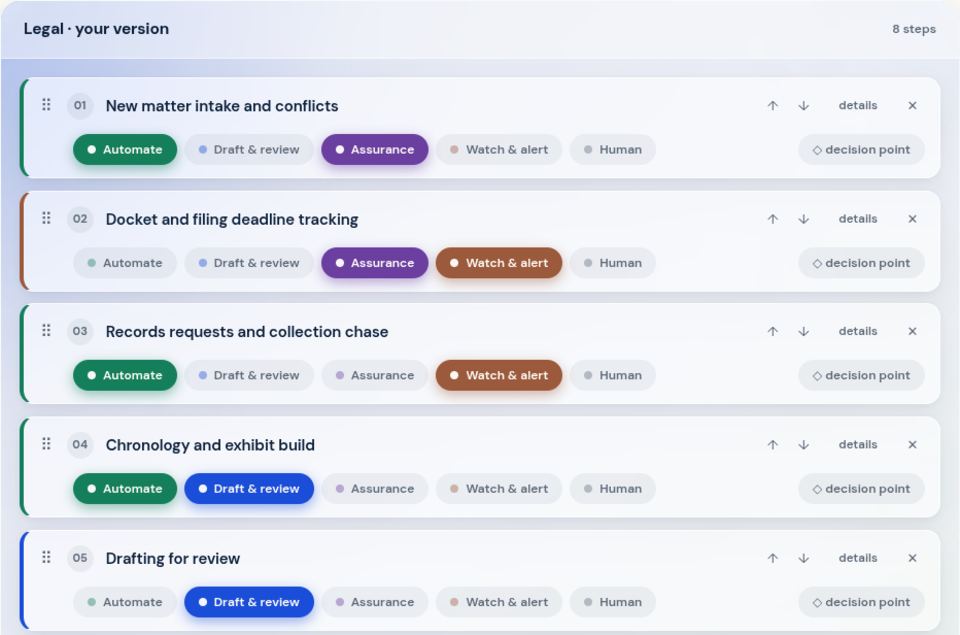
Draw the workflow that hurts: drag the steps into your real order, tag what each one is, and send the map. Ten minutes, no account. Nothing is stored or sent until you email it.

Open the builder
How pricing works

Scoped before it is priced.

We do not publish a rate card, because the work is never the same twice. Pricing a national rollout and a six-person practice from the same template would be dishonest to one of them.

First, the diagnosis

We scope the work before anyone quotes it

The diagnostic is quoted to the size of your firm and the ground it covers, and it is credited toward whatever engagement follows. You keep the written map either way, including the version that says you need a checklist and one hire, not agents.

Then, a written ceiling

The number is agreed before work begins

Your proposal names the scope, the price, and a ceiling that holds for the term. Nothing is billed that was not scoped, and nothing is scoped that the diagnosis did not support. Executive briefings book directly, no diagnosis required.

Book a working session

The conversation is free.
The diagnosis is where it starts.

Solutions · by industry

Built for the way your
industry actually works.

The same five-stage engine, tuned to the documents, deadlines, and regulators of your world. Every engagement starts with the diagnosis. These are the worlds where our playbooks run deepest.

Market evidence
0–80%

Of listed businesses never sell, and messy financials are a leading killer.
Source: IBBA Market Pulse reporting

Market evidence
Months → days

What AI permitting prescreens have done to review queues in cities already deploying them.
Source: public-sector deployment reporting

Market evidence
~0K

Actively licensed US CPAs remain, down from ~1.9M in 2019. The shortage every regulated industry feels.
Source: AICPA Trends · NASBA

Whatever the industry

Three things stay constant.

Audit first

The Audit maps your workflow before anything is proposed. If the honest answer is advice, not software, that's the report you get.

A written ceiling

Scope and price are agreed before work begins, and the ceiling holds for the term. No industry, no exception.

Measured against day one

Your baseline is recorded at the start; every claim of improvement is a delta against it, shown to you monthly.

Common questions

Asked by operators in every industry.

Do you only work in these industries?

No. Makes Eleven is a general consultancy: any firm, any industry, case by case. These are the verticals where our playbooks already run deepest. If yours isn't listed, the diagnostic works exactly the same way.

What does an industry engagement actually start with?

The diagnostic. You get a written map of how work flows through your firm, what to automate, what to fix first, and what to leave alone. It is scoped to your firm, credited toward whatever follows, and it is a deliverable you keep whether or not you continue.

Who reviews the regulated output?

Licensed professionals. Financial deliverables are prepared by our agent systems and reviewed and approved by licensed CPAs in our delivery network, disclosed plainly in every engagement letter. Agents never sign, file, or pay; that's contractual.

Will this replace the systems we already use?

No. The agent layer sits on top of your existing systems by API. We never migrate your ledger, your practice management system, or your CRM; the agents work between them.

How is pricing set?

By scope, never by template. We do not publish a rate card, because a national rollout and a single-office practice are not the same work. The diagnosis establishes what the work actually is; the proposal names the price and a written ceiling that holds for the term.

Start where you are

Your industry, mapped in ten minutes.

Open the Workflow Builder
Solutions · by function

Every function of the business.
One engine underneath.

No function leads and none is an afterthought. The same five-stage machine runs any of them where documents move, deadlines bind, and follow-up decides outcomes.

Every function, one engine

Every function of the business runs on the same five stages.

Accounting, finance, HR, operations, compliance, legal: the same signal → enrich → score → compose → act spine, tuned to the documents and deadlines of that function. Agents assemble; licensed professionals review anything regulated; every step is measured against your day-one baseline.

Accounting

Clean records, reconciled accounts, and a close that happens on a date. Agents assemble; licensed CPAs review and approve.

Sample use cases →

Finance & FP&A

A 13-week cash forecast that reconciles to the ledger, not to hope. Variance flagged with sources attached.

Sample use cases →

HR & People

Onboarding and offboarding chases that never lose a step; credential and license expiry watched continuously.

Sample use cases →

Operations

The exception board: one queue for everything stuck, with an owner and a clock on every item.

Sample use cases →

Marketing & Growth

First-party lifecycle triggers on consented channels only. Relevance from your own data. No scraping, no purchased lists.

Sample use cases →

Sales & CRM

Pipeline hygiene enforced automatically; quote-to-close follow-up that's polite, relentless, and logged.

Sample use cases →

IT & Data

Access reviews on schedule, unused licenses reclaimed, backups verified by restoring them, not by trusting the checkbox.

Sample use cases →

Compliance & Risk

Obligations tracked from the governing documents, filings calendared with margins, evidence collected as the year happens.

Sample use cases →

Legal & Contracts

Renewal and notice dates computed from the contracts themselves. Obligations surfaced before they bite; drafts assembled for counsel.

Sample use cases →

Customer service & Front office

Intake triaged, routine questions answered from approved sources, everything else routed to a human with context attached.

Sample use cases →

Procurement & Vendors

Invoices reconciled against contracts and price lists, vendor documents chased to completion, renewals never auto-renewed unseen.

Sample use cases →

Data & Reporting

The numbers assembled, sourced, and explained on schedule. Your own data, queryable in plain English.

Sample use cases →

Enablement & Training

Executive briefings for leadership, workflow-anchored training for teams. People are the other half of eleven.

See enablement →
Common questions

How function engagements work.

Can we start with just one function?

That's the recommended path. The diagnosis picks the function where proof is fastest, we run it to a measured result, and expansion follows evidence, never enthusiasm.

Do you favor one function over the others?

No. The diagnosis picks the function where proof lands fastest for your firm. Accounting shows up often because bookkeeping is recomputable, so a second independent calculation can verify every number, but that is a property of the work, not a ranking of our services.

Do these connect to our existing tools?

Yes, by API, on top of what you already run. We never migrate your ledger or CRM; the agents work between your systems and leave the source of truth where it is.

What never gets automated?

Signatures, filings, and payments; tax positions and valuation opinions; anything leaving for a regulator, court, or counterparty without human review. The full refusal list is on the Method page, and it is contractual, not just stated.

Find the function that hurts

Ten minutes. Your map. No account.

Open the Workflow Builder
Insights

Notes from the founder,
and the reading behind them.

Positions, industry updates, and the primary sources worth your time. Everything here follows the house rule: sourced answers or a refusal.

The Makes Eleven letter

Occasional, short, specific: what changed in AI for regulated work and what we would do about it. No filler.

Founder's notes

Positions, in writing.

AUG 2026Method

Why the diagnosis comes first, and why there is no rate card

Most AI engagements fail before the first line of configuration, because nobody mapped the workflow the software was supposed to run.

Read the note

Every failed automation project I've examined shares one property: the prescription came before the diagnosis. A tool was chosen, then a problem was found for it. We run the arrow the other way. Nothing gets proposed until we have mapped how work actually moves through the firm, and the map is a written deliverable you keep whether or not you continue.

That sequence is also why there is no rate card on this site. A published number is a promise made before the work is understood, and it fails in both directions: a national firm auditing every entity gets quoted as though it were a single office, or a six-person practice gets quoted as though it were an enterprise. Both are wrong. The scope has to exist before the number does, so we scope first and price to what we find.

What replaces the rate card is a discipline, not a mystery. The diagnosis is quoted up front and credited toward whatever follows. The proposal names the scope, the price, and a ceiling that holds for the term. Nothing gets billed that was not scoped, and nothing gets scoped that the diagnosis did not support.

The honest finding ("you don't need agents, you need a checklist and one hire") costs us the engagement and still gets written down. It appears in more diagnostics than you would think. If a proposal ever contains something the diagnosis doesn't support, you're holding the wrong proposal. That's the whole method.

AUG 2026Accounting

We built for the CPA shortage on purpose

Roughly 650,000 actively licensed CPAs remain in the US, down from about 1.9 million in 2019. That is an architecture problem, not a staffing problem.

Read the note

The profession isn't coming back to its old headcount, and every firm that needs reviewed financials is competing for the same shrinking bench. You can pay more for the same hours, or change what the hours are spent on.

Our architecture does the second thing. Agents do the volume: categorization, reconciliation, assembly, chase. Licensed CPAs do what only they can: review, judge, approve, sign. The disclosure is printed in every engagement letter, because the model only works if the client knows exactly who did what.

The shortage is the market evidence for the whole design. A CPA reviewing agent-prepared workpapers covers a multiple of the clients they could serve preparing everything by hand, and the work they keep is what their license was for.

AUG 2026Accounting

GAAP is a ladder, not a leap

Full GAAP on day one is over-prescription for most owner-led firms. The honest version is five rungs and an honest stopping point.

Read the note

GAAP is the reference standard buyers, lenders, and bonding agents actually use, which is exactly why it gets oversold. A firm with no exit on the horizon, no institutional financing, and no outside investors doesn't need ASC 842 workpapers; it needs reconciled accounts and a close that happens on a date.

So we sell a ladder: records → reconciled → accrual → GAAP-ready → diligence-ready. Clients enter wherever their books actually are, and full GAAP is triggered by something real (an exit inside two years, a covenant, a bond, an investor), not defaulted. No trigger? Stopping at rung three is the "never sell what you don't need" doctrine, applied to our own accounting build.

The rungs above stay lit for the day something real turns on. That's the difference between a ladder and a leap: you can stand on a ladder.

Curated reading

The sources worth your time.

The primary documents behind the claims we make. Read them yourself.

Curation rule: primary sources and measured data only. No vendor decks, no hype cycles.

Why now

The engine arrived. The road didn't change.

Almost every firm has bought the tools. Very few have changed the work. That gap, not the technology, is the story of the last three years. It is why a small firm can now outrun a large one.

The first mistake

Rockets on a horse.

“We are, in many cases, bolting a jet engine onto a horse carriage — and wondering why it doesn’t fly.”

This is what most AI adoption looks like. The model is genuinely powerful. It is strapped onto a process shaped entirely by human limits: an eight-hour shift, a sequential handoff, an approval that waits for Monday.

The thrust is real. The animal underneath it is the constraint. You get a faster horse, a louder one, and an expensive one. The finish line does not move.

The tell is easy to spot in your own firm: the tool got adopted, everyone says it helps, and no line on the P&L moved.

A galloping horse with a rocket strapped to its back, thrusters firing.
Fig. 01 · More power, same animal
The second mistake

A Formula One engine in city traffic.

“The engine’s power is there, but the full potential is squandered by the limits of the road.”

Suppose the technology is right and the deployment is competent. It still sits inside a process with a red light at every intersection: a queue, a weekly meeting, a shared inbox, a person who has to notice.

An agent that can work through the night is worth nothing if the next step waits until someone opens a folder on Tuesday. Throughput is set by the slowest gate, not the fastest actor. That is why pilots post a real speed gain on one step and no change in cycle time.

This is the diagnosis most firms never get: not which tool, but which intersection.

Overhead view of a Formula One car boxed in by ordinary traffic at a red light. Fig. 02 · Throughput is set by the gate, not the engine
What the measured data says

This is not a hunch. It is the most consistent finding in the field.

Three independent bodies of research, all pointing at the same gap between adoption and earnings. We publish the sources so you can check them.

Adoption
0%

Of organizations report using AI in at least one business function, up from 78% the year before. The tools are, effectively, everywhere. Source: McKinsey Global Survey on AI, 2025

Earnings impact
0%

Report any measurable effect on enterprise-level EBIT. Among those, most attribute under 5% of it to AI. Widespread use, narrow result. Source: McKinsey Global Survey on AI, 2025

Pilots
0%

Of enterprise generative-AI pilots studied delivered no measurable P&L impact. The authors attribute the divide to approach, not to model quality. Source: MIT Project NANDA, The GenAI Divide: State of AI in Business 2025

Read the argument at its source. The framing on this page follows Hofmann, D. & Kruhse-Lehtonen, U., “The agent-centric enterprise,” Harvard Data Science Review (DAIN Studios), which introduces the Agent OS framework and the A.G.E.N.T. playbook. Their executive summary puts it plainly: AI is being bolted onto workflows designed for humans, not machines, and that structural mismatch is what guarantees disappointing results.
What actually differs

Two operating models, six design decisions apart.

Every firm sits somewhere on this table. Which model you bought matters far less than how the work was shaped before it arrived.

DimensionHuman-drivenAgent-driven
Process design
Optimized for human comprehension
Optimized for autonomous execution
Knowledge
Tacit; it lives in people's heads
Explicit and machine-readable
Work allocation
By role and department
By capability and availability
Coordination
Meetings and email
Real-time protocols between agents
Improvement
Periodic review cycles
Continuous, and logged
Reported productivity
20–40% incremental
2–10× on selected processes

Comparison and the reported productivity ranges from Hofmann & Kruhse-Lehtonen, “The agent-centric enterprise,” Harvard Data Science Review, citing Noy & Zhang (2023), Riedl et al. (2023), OECD (2025), McKinsey (2025) and BCG (2025). The second column is the destination, not a promise. Which row you can honestly move is what a diagnosis is for.

Read the middle column carefully. Knowledge that lives only in people's heads is the single most common blocker we find, and it is not a technology problem. Before an agent can carry any weight, the playbooks, decision criteria and operating procedures it works from have to exist in writing. That work is unglamorous, it is most of the first engagement, and skipping it is why pilots stall.
What actually works

Rebuild the road.

Nothing above is an argument against the technology. It is an argument about where the work happens. When the process itself is redesigned so an agent can act, with data reachable and gates placed deliberately, the same engine finally gets to run.

That redesign is a specific, ordinary, repeatable exercise. It has five moves, it takes weeks rather than quarters, and it starts with one workflow, not a transformation program.

It also has a boundary that never moves: the gates you keep are the ones that carry judgment, liability, or a signature. Those are not inefficiencies to be removed. They are the reason anyone trusts the output.

SIGNAL ENRICH SCORE COMPOSE HUMAN · SIGNS SAME ENGINE NEW ROAD GATES DELIBERATE Fig. 03 · The gate you keep is the one that carries judgment
What changes on the other side

The point was never headcount. It was where your best people spend Tuesday.

Execution → orchestration

When agents handle routine execution, people move up to problem framing, trade-offs, stakeholder alignment, and leadership under uncertainty. You hired them to think, not to retype.

A consistent floor

Manual work varies. A designed workflow sets a floor that holds no matter who is out. Consistency is worth more to a regulated firm than raw speed.

Return on inference

The measure shifts from return on investment to return on inference: what each unit of machine reasoning actually produced. Harder to fake than a license count, which is why we track it.

Agency, not autonomy

Autonomy is how much a system may do alone. Agency is how much your people can direct it. We build for agency and raise autonomy only where the evidence earns it. Never the reverse, never quietly.

Start where it costs you

Pick one workflow. Map it. Then decide.

The Workflow Builder takes about ten minutes and needs no account. You leave with your own map: the steps, the gates, and where a machine could carry weight. Yours whether or not you ever hire us.

The method we run

Audit. Gauge. Engineer.
Navigate. Track.

Five moves that take a workflow from “this is slow and nobody knows why” to “this is measurably better and the CEO believes the number.” Every engagement runs them in this order. Each stage ends in an artifact you keep.

Before the first letter

The playbook doesn’t start with a workflow. It starts with what the business is for.

Picking a workflow first is how firms end up automating something that works fine. Four questions come before Audit, and they take an afternoon, not a quarter.

Step 00Business objectives

What is the firm actually trying to do this year? Everything downstream has to trace back to a line on this list or it doesn't get built.

Step 01Your agentic position

What role should machines play here, and where should they not. This is where refusals get written.

Step 02Opportunity identification

Systematically, across the value chain, not from a vendor list. The biggest pain points are usually common knowledge; the work is confirming which are tractable.

Step 03Select the first workflow

Strategically important, but safe enough to experiment on. One workflow, chosen deliberately, not a transformation program.

A

Audit

“What is actually happening, and why does it fail?”

Understand how the work is done today and what outcome really matters, not what the process document says. Everything downstream inherits whatever this stage got wrong.

The playbook
  • Map goals, data, systems, roles
  • Interview users; capture pain points
  • Document desired outcomes, not just outputs
How we run it
  • Sit with the people doing the work, not only the people managing it
  • Start from the relevant Workflow Atlas board so you edit a draft rather than face a blank page
  • Record the gates that exist by design and the ones that exist by accident
You leave with

A written picture of the as-is and the target outcome. Useful even if you stop here.

G

Gauge

“What would success look like for the business?”

Evaluate each workflow on impact, repeatability, complexity and outcome potential. This is the stage that decides what we will not build. A step that is high-risk, low-volume and dependent on judgment is a step that should stay exactly where it is.

The playbook
  • Score steps on repeatability and risk
  • Estimate outcome upside
How we run it
  • Every step lands in one of five categories: automate, draft & Review, assurance, watch & Alert, or human-always
  • The human-always register is written before anything is built, and it may grow but never shrink
  • The success number is picked here: one number, agreed in writing, before work starts
You leave with

A prioritized shortlist of agent opportunities, and a documented list of what we declined to touch.

E

Engineer

“If you started fresh with AI, what would this look like?”

Redesign and build the flow so an agent can act: data accessible, decisions explicit, handoffs deliberate. This is where the road gets rebuilt rather than repaved, and where most programs quietly skip ahead to tooling.

The playbook
  • Refactor the process for straight-through flow
  • Build or configure the agent
  • Define success metrics and guardrails
How we run it
  • Everything is built on the same five-stage spine: signal, enrich, score, compose, act
  • Autonomy is set per task against our written reliability standard, not per system
  • A separate examiner checks what the builder built; licensed professionals review anything regulated
You leave with

A working agent-first process ready to pilot, with measurable success criteria attached to it.

N

Navigate

“Who decides what, and what happens when AI is wrong?”

Shape the human–agent relationship: transparency, intervention paths, governance. Assume the system will be wrong at some point, and design the moment of being wrong before it happens rather than after.

The framing that matters here: the system is not doing the regulated work. It is preparing expert work for controlled approval, which is why accountability stays where the risk is created.

The playbook
  • Add explainer UI, override and escalation paths
  • Train staff on the new oversight roles
  • Embed compliance checks
How we run it
  • Every output carries its sources, its confidence and the record of what it touched
  • Signatures, filings and payments stay human. Printed in the contract, not just implied
  • The people who will supervise the agents are in the room while it is designed, not briefed afterward
  • Human review is a catalyst, not a brake: validated output earns a system more autonomy later
You leave with

Human control that holds as autonomy rises, because the escalation path was built, not promised.

T

Track

“Would your CEO believe these numbers?”

Prove value against the outcome chosen in Gauge. Show the honest comparison: not just before and after, but what would have happened anyway.

The playbook
  • Instrument KPIs and dashboards
  • Run A/B or before-and-after comparisons
  • Feed learnings into the next Audit cycle
How we run it
  • Measured against your day-one baseline, published to you monthly
  • A short dashboard on purpose: source, freshness, confidence, exceptions needing a human
  • What proves out scales; what doesn't, we stop. Proof, then scale
You leave with

Outcome gains that fund the next move, or a documented reason to stop. Both are results.

Naming the parts

Five kinds of agent. The question is never “where can we use AI.”

It is “which kind of agent should own this step, and where does a human stay in control.” A taxonomy connects the technology to your actual pain points. Without one, every conversation collapses into tool shopping.

TypeScopeAutonomyWhere it shows up in a firm like yours
Assistant
Draft, summarize, answer, retrieve
Assist
Client correspondence, policy questions, meeting notes. Most firms already run this layer, which is why most firms mistake it for the whole thing.
Analyst
Analyze, forecast, simulate, recommend
Recommend
Variance review, risk flags, pricing and pro-forma scenarios, compliance exposure. Real leverage starts here.
Tasker
Execute one bounded action through a tool or API
Act, within limits
File the record, chase the document, update the ledger, open the matter. Bounded, logged, and reversible by design.
Orchestrator
Plan and run multi-step, cross-system work; delegate to other agents
Act or own, with escalation
The close, the recertification cycle, intake through demand letter, permit routing. This is where a workflow stops being a checklist and becomes a system.
Guardian
Monitor, evaluate, enforce policy, audit the other agents
Assist / recommend
Privacy checks, financial control gates, review of what the other agents produced. We build this one on every engagement, not on request.

Taxonomy adapted from Hofmann & Kruhse-Lehtonen, “The agent-centric enterprise,” Harvard Data Science Review. The Guardian row is where our reliability standard lives: a separate examiner checks what the builder built.

The shape of a first engagement

One workflow. Roughly eight weeks. Then you decide again.

The published sprint runs in three phases. We keep that shape because it forces a visible result early, while the people who will live with the system are still in the room.

Weeks 1–2Audit & Gauge

Identify the high-value workflow, map its current state, and find where the time actually goes. Choose the one number that will decide whether this worked.

Weeks 3–5Engineer

Build and deploy the first agent workflow, with attention on data accuracy and the routine work that consumes the day. Guardrails ship with it, not after it.

Weeks 6–8Engineer · Navigate · Track

Scale what works, learn from what didn't, wire the oversight, prove the number. Then repeat on the next workflow.

Sprint structure adapted from Hofmann & Kruhse-Lehtonen, “The agent-centric enterprise,” Harvard Data Science Review. Scope, duration, and price are set per engagement; a six-person practice and a national rollout are never the same shape.

Stage one, on the house

The Audit starts with a map. Draw yours now.

The Workflow Builder is the first half hour of Audit, run by you, for free. It becomes the pre-call assessment if we speak, and a useful document if we never do.

Members

Sign in to your
practice’s workspace.

Your firm’s atlas, its portal, and the four training quarters — in one place, for everyone on the membership.

Members

Choose a new
password.

This link works once. Setting a password here signs out every device that was signed in, including whichever one prompted you to do this.

Consultations

What a conversation costs,
before you book one.

Every session is free to book. What costs money is the Audit itself — $4,500, invoiced when you engage, scoped in the session that carries its name. The price is here, not on the calendar.

Every session is on Zoom unless you ask otherwise. If none of these is the right shape, say so at [email protected] and we will find one that is.

Prompt Studio

Piloting: say it so
the machine can carry it.

Nine fields, each one a lesson. Fill them honestly and the Studio assembles a production-grade prompt — test it here, copy it anywhere, and save the good ones to your firm’s shared library.

Invitation

Join your firm’s
membership.

A colleague has added you to their firm’s Makes Eleven membership.

Your account

Settings, membership
and how you sign in.

What your firm holds, who is on it, and the details that are yours to change.

Membership

Priced per practice,
not per person.

A membership belongs to the firm. Everyone in it inherits what the firm bought, so adoption is never taxed by the seat count — which would punish exactly the thing being sold.

Fourteen days to change your mind on a first purchase, no questions asked. The refund policy says so in full.

Loading plans…

What every membership includes

  • The full atlas for your vertical. Every board, not the one open board.
  • The portal. Its processes, each with how far autonomy may go and the seat that can stop it.
  • Four training quarters. Audit, Gauge, Engineer, Navigate & Track — against your own work.
  • Up to ten seats on a single vertical; unlimited on enterprise. Colleagues on your work domain join themselves.
  • No trial clock. The free material is permanently free, so you can judge it before paying rather than during.

Prices in US dollars, billed per firm. By subscribing you agree to the terms, the privacy policy and the practice disclaimer — which says plainly that this is operational guidance for running a practice, not legal, tax, accounting or compliance advice.

Legal

Terms of service.

What a Makes Eleven membership is, what it isn’t, and what each of us owes the other.

Legal

Privacy policy.

Short, because there is little to declare. We collect what a membership needs to work, and nothing to sell.

Legal

Refunds and cancellation.

Stated here and on the plans, so nobody discovers it after paying.

Legal

The practice disclaimer.

The one that matters most, given who is reading. Guidance for running a practice is not advice about practising.